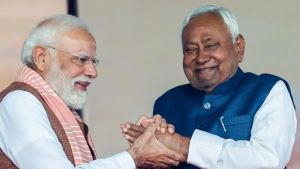
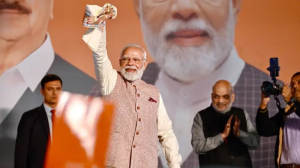
According to news agency ANI, Prime Minister Narendra Modi met with members of the Indian diaspora upon his arrival at the Sheraton Hotel in Hiroshima on Friday. Modi’s visit to Japan marks his participation in the annual G7 summit scheduled from May 19 to 21. Notably, this is the first time an Indian Prime Minister has visited Hiroshima since India conducted nuclear tests in Pokhran in 1974. The last Indian PM to visit Hiroshima was Jawaharlal Nehru in 1957, when he paid his respects to the city that had endured the devastating atomic bomb attack in 1945.
Modi’s presence in Hiroshima holds significance as India remains one of the few countries that has not ratified the Nuclear Non-Proliferation Treaty (NPT). During his time in Hiroshima, the Prime Minister will join the G7 leaders in visiting the Peace Memorial Park, a poignant site dedicated to honoring the victims and survivors of the atomic bomb attack.

World Leaders in G7
As the G7 leaders convene in closed-door sessions and indulge in a sumptuous seafood feast, we will temporarily halt our live coverage for the day.
The focus of today’s discussions centered around the ongoing conflict in Ukraine, and this topic is likely to persist during the leaders’ working dinner.
Here are some of the key highlights we covered during the G7 summit:
- Agreement on Imposing Additional Sanctions on Russia: The leaders reached a consensus on imposing further sanctions against Russia and emphasized the imperative for a complete withdrawal of Russian troops from Ukraine.
- Potential Attendance of Ukraine President at the G7 Summit: There have been indications that Ukraine President Volodymyr Zelensky may travel to Japan for the G7 summit, although specific details remain limited at this time.
- Zelensky’s Presence at the Arab League Summit: In the meantime, President Zelensky has arrived in Saudi Arabia to participate in the Arab League summit.
- Commemoration at Hiroshima’s Peace Memorial: As a gesture of tribute to the victims of the atomic bomb attack during World War Two, which claimed the lives of approximately 140,000 individuals, the G7 leaders paid their respects by laying wreaths at Hiroshima’s peace memorial.

What id G7 (Group of Seven)?
The Group of Seven (G7) is an international intergovernmental organization consisting of seven major advanced economies: Canada, France, Germany, Italy, Japan, the United Kingdom, and the United States. The European Union also participates in G7 meetings. The group represents countries with high-income economies and accounts for a significant share of global economic output.
The G7 originated in the mid-1970s as an informal forum for leaders of the world’s leading industrialized democracies to discuss pressing global issues. Over time, the group evolved into an annual summit where leaders engage in discussions on a wide range of topics, including global economic stability, trade, climate change, security, and global governance.
The primary goal of the G7 is to foster cooperation and coordination among member countries to address global challenges and promote economic growth and development. The G7 meetings provide an opportunity for leaders to exchange views, share experiences, and develop joint approaches to common problems.
Some of the key areas of focus for the G7 include:
- Economic Cooperation: The G7 countries aim to promote global economic stability, sustainable growth, and financial market regulation. They discuss economic policies, trade issues, and financial market developments to strengthen international economic cooperation.
- Climate Change and Environmental Issues: G7 leaders address climate change, sustainable development, and environmental challenges. They work towards reducing greenhouse gas emissions, supporting clean energy technologies, and promoting environmental conservation.
- Global Security and Peace: The G7 discusses security issues, counterterrorism efforts, non-proliferation of weapons of mass destruction, and regional conflicts. The leaders aim to enhance global security and promote peace and stability.
- Development and Humanitarian Aid: G7 countries support development initiatives, poverty reduction, and humanitarian assistance in less developed regions. They focus on issues such as education, health, gender equality, and sustainable development.
- Global Governance: The G7 seeks to strengthen global governance by addressing issues related to international institutions, multilateral cooperation, and rules-based systems. They work towards enhancing the effectiveness and legitimacy of global institutions.
In recent years, the G7 summits have expanded to include outreach sessions with other countries and international organizations to ensure broader representation and engagement. The G7 also collaborates with other forums and initiatives, such as the G20, United Nations, World Trade Organization, and regional organizations, to amplify its impact and promote global cooperation.
While the G7 does not have formal decision-making power or enforceable agreements, its influence stems from the political weight and economic significance of its member countries. The G7 statements and commitments often set the agenda and influence global policy discussions, serving as a platform for coordination and consensus-building among its members.
It’s important to note that the G7’s composition and relevance have been subject to debate, as some argue for greater representation of emerging economies and a broader range of perspectives in global decision-making. Efforts have been made to include other countries and stakeholders through outreach and dialogue to address these concerns and ensure a more inclusive and effective international cooperation framework.
Please note that our live coverage will resume at a later time, providing further updates on the ongoing G7 summit proceedings.
About The Author