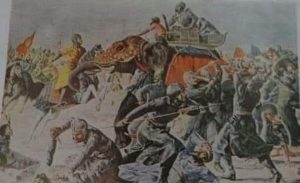
The year was 1947. India was witnessing one of the most harrowing events in its history—the Partition. This division of the nation led to the creation of two independent states, India and Pakistan, and with it, the largest mass migration in human history. Millions were uprooted from their ancestral homes, seeking refuge across borders amidst unimaginable violence, fear, and loss. The Old Delhi Railway Station, then and now, stands as a poignant reminder of this painful chapter in history.
For the past 75 years, Delhi has transformed dramatically. Flyovers have been constructed, the metro system has expanded, and shopping malls have mushroomed across the city. However, the Old Delhi Railway Station has remained much the same—a silent witness to the passage of time and the countless stories of human endurance, despair, and hope that unfolded on its platforms.

The Clock That Saw It All
The clock above the main gate of the Old Delhi Railway Station is not just a timepiece; it is a relic of a time when Hindu and Sikh refugees arrived from Pakistan, seeking shelter and survival. These refugees had escaped with their lives from brutal attacks and massacres, often leaving behind everything they owned. The station became the first stop in India for thousands of these displaced souls.
Even today, in the streets of Delhi, one can still find elderly men and women who lived through those dark days. With bent backs and wrinkled faces, they carry the memories of their harrowing journey to safety—a journey that often began at this very station.

The Painful Journey
As Hindu and Sikh refugees poured into India, many disembarked at the Old Delhi Railway Station and Amritsar Station. Meanwhile, in a cruel irony of fate, looted and battered Muslims were being sent to Lahore from the Lodhi Colony Railway Station, starting a new life in Pakistan.
One of the most iconic figures of Indian athletics, Milkha Singh, arrived at the Delhi Junction as a lone, orphaned 16-year-old boy. The man who would later be known as the “Flying Sikh” had witnessed the brutal murder of several family members during the Partition. His journey was not a direct one; from his hometown in Kot Addu, Western Punjab, he first traveled to Multan by train and then to Firozpur by truck before finally arriving in Delhi. His father’s last words, “Run Milkha, run,” still echo in the tales of that time. Milkha Singh was separated from his sister during their escape, and the trauma of those days haunted him for the rest of his life.
Delhi during that period was a city in chaos. Refugee camps were overflowing, and every day brought new waves of people fleeing from the other side of the border. Milkha Singh’s primary purpose in Delhi was to find his lost sister, a mission in which he eventually succeeded. However, the scars of the Partition ran deep, and the memories of those horrific days were something Milkha Singh could never forget.

The Refugee Crisis at Old Delhi Railway Station
For the refugees arriving at the Old Delhi Railway Station, the journey was far from over. Most had no place to go and no means of sustenance. Their only goal was to cross the border into India, where they hoped to find safety. But the trains to Delhi were often attacked in remote areas, turning their journey into a perilous ordeal.
Former Railway Board Chairman YP Anand recalls his family’s harrowing journey from Sialkot to Jammu. After riots broke out in Sialkot, staying there became impossible, and the family attempted to flee. During their 21-kilometer train journey, their train was attacked by rioters. Anand, who was just 13 at the time, witnessed the brutal massacre of half of his family. The train, covered in blood, eventually reached Jammu. A few days later, the surviving members of the family arrived at the Old Delhi Railway Station, where thousands of refugees were camped in makeshift tents around the station.

The Tale of Bhisham Sahni’s “Amritsar Aa Gaya Hai”
The horrors of the refugee trains have been immortalized in the literature of that time. Renowned author Bhisham Sahni’s short story “Amritsar Aa Gaya Hai” vividly captures the fear and uncertainty faced by passengers traveling from Rawalpindi to Delhi. As his family made the perilous journey by train, they were constantly haunted by news of massacres and attacks. Sahni’s narrative encapsulates the harrowing experience of many refugees who witnessed unspeakable violence before finally arriving at Amritsar, where doctors and officials awaited the severely injured and sick.
For Sahni, August was a month of mixed emotions. Born on August 8, he also remembered it as the month he was forced to leave his birthplace, Rawalpindi, because of the Partition. He eventually settled in East Patel Nagar, Delhi, where he spent the rest of his life, becoming a prominent figure in Indian literature and education.

The Shifting Demographics of Delhi
As the refugees continued to pour into Delhi, the city’s demographics began to shift dramatically. Areas such as Subzi Mandi, Karol Bagh, Daryaganj, and Kashmiri Gate became home to thousands of newly arrived refugees. Many had no choice but to live in tents or on the streets. In the mornings and evenings, places like Gurudwara Sis Ganj, Gauri Shankar Temple, and various charitable organizations provided meals to these displaced families.
For those lucky enough to find a roof over their heads, it was often in makeshift shelters like schools or temples. For instance, the Valmiki Mandir on Panchkuian Road became a refuge for some families. Meanwhile, others would visit the Old Delhi Railway Station daily, hoping to find lost relatives or friends among the new arrivals.

The Impact on Subzi Mandi Station
While Old Delhi Railway Station was a major hub for arriving refugees, Subzi Mandi Railway Station also saw its share of displaced people. Many of them had nowhere to go and ended up staying at the station for days. The residents of Subzi Mandi Railway Colony, which was established in the 1930s, generously provided food and shelter to these refugees. The area around Subzi Mandi, including places like Ghanta Ghar, Sadar Bazaar, Chandni Chowk, and Bara Hindu Rao, soon became populated with refugee families.
One of the notable refugees who arrived in Delhi during this time was Chunni Lal Gulati from Sialkot. His family, which was in the spice trade, eventually established MDH (Mahashian Di Hatti), one of India’s most famous spice brands. The founder, Mahashay Dharampal Gulati, always regarded Karol Bagh, where they first settled, with deep reverence. He famously avoided wearing shoes there, considering it a sacred place that gave him everything he had.

Refugees and the Changing Face of Delhi
The mass migration of refugees into Delhi did not go unnoticed by the local population. Many of the city’s residents were apprehensive about the sudden influx, fearing it would drastically alter Delhi’s social fabric. However, the refugees brought with them resilience, determination, and the will to survive. Many of them, like the trio behind Delhi’s iconic Moti Mahal restaurant in Daryaganj, which popularized dishes like butter chicken, went on to become successful entrepreneurs, shaping the city’s culinary and cultural landscape.
The city also saw an influx of prominent figures like Jagannath Azad, a poet who was commissioned by Jinnah to write Pakistan’s first national anthem. Azad and his family arrived at Old Delhi Railway Station and settled near Pul Bangash. His home became a gathering place for renowned Urdu poets like Firaq Gorakhpuri. Despite his significant contribution to Pakistan’s early days, Azad chose to live in India after Partition, where he continued to influence the literary world.

The Journey from Lahore to Delhi
Not all refugees arrived by train. Some, like the renowned author and journalist Khushwant Singh, drove from Lahore to Delhi. Singh described the desolate and eerie silence of the countryside, which was only broken by the sight of people as they neared Delhi. His cousin, Bhai Mohan Singh, also made the journey by car, bringing his family from Rawalpindi to Delhi. Singh’s cousin later founded Ranbaxy Laboratories, one of India’s largest pharmaceutical companies.
For the wealthy, who could afford to travel by car, the journey to Delhi was relatively safer. But for most refugees, the journey by train was a matter of life and death, with the constant threat of attacks looming over them.

Conclusion: A Monument to Survival
The Old Delhi Railway Station remains a monument to the resilience and survival of the countless Hindu and Sikh refugees who passed through its gates. Each brick and beam of the station bears silent witness to the stories of loss, separation, and ultimately, survival that defined the lives of millions during the Partition of India. As Delhi continues to evolve, the Old Delhi Railway Station stands as a reminder of the city’s complex and often painful history—a history that has shaped the lives of many who call Delhi home today.

Did you know?


About The Author