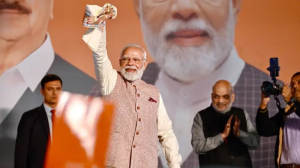
Demonetisation refers to the act of stripping a currency unit of its status as legal tender, usually by replacing old currency notes with new ones. In the context of India, demonetisation specifically refers to the move taken by the Indian government in November 2016, when Prime Minister Narendra Modi announced the discontinuation of the existing ₹500 and ₹1,000 currency notes as legal tender.
The primary objectives cited by the government for demonetisation were:
- Curbing black money: The government aimed to crack down on the parallel economy and curb the circulation of unaccounted money, often referred to as “black money.” By invalidating the higher denomination notes, it was expected that those holding illegal wealth would be forced to declare it or face severe consequences.
- Combating corruption: Demonetisation aimed to reduce corruption by making it difficult for individuals involved in illicit activities to use large cash transactions for bribes, kickbacks, or other illegal purposes.
- Addressing counterfeit currency: The government sought to tackle the issue of counterfeit currency notes that were being circulated, particularly in the higher denominations. The new currency notes introduced after demonetisation were designed with enhanced security features to make counterfeiting more difficult.
- Promoting digital transactions: Demonetisation was seen as a catalyst to promote a shift towards digital transactions and a less cash-dependent economy. The government encouraged the use of electronic payment systems and digital platforms to facilitate financial transactions and reduce the reliance on physical currency.
While the intentions behind demonetisation were aimed at addressing these issues, the implementation of the policy faced challenges, resulting in various socioeconomic impacts. Critics argue that the sudden withdrawal of a significant portion of the currency in circulation led to disruptions in the economy, particularly affecting the informal sector and small businesses. Additionally, the effectiveness of demonetisation in achieving its stated objectives, such as curbing black money or reducing corruption, remains a topic of debate among economists and experts.

Why middle class is not happy with the demonetisation?
Demonetisation is a political and economic initiative that was announced by Prime Minister Narendra Modi on November 8, 2016. Under this initiative, the existing ₹500 and ₹1,000 currency notes were invalidated from the Indian economy, and new ₹500 and ₹2,000 notes were introduced.
The main objectives of demonetisation were to tackle corruption, eliminate black money, curb illicit activities associated with cash transactions, and promote a digital economy in India.
However, the impact of demonetisation was widespread, and the decision faced significant controversy. Many people had to endure difficulties and inconveniences, and the economy experienced a temporary slowdown. Additionally, some individuals failed to understand the benefits and purpose of demonetisation.
Post-demonetisation, the economy faced challenges, and many Indians became disillusioned with the lack of anticipated economic and social improvements. Consequently, a section of the Indian middle class began expressing discontent with demonetisation. They believed that it had adversely affected their economic situation and caused inconvenience. Moreover, they felt that demonetisation did not effectively combat illicit activities and also impacted industries.
As a result, many middle-class Indians expected a focus on corruption, economic reforms, and employment, but they started losing faith in these areas after demonetisation.
Impact of demonatization ?
Demonetisation had both positive and negative impacts on the Indian economy and society. Here are some of the key effects:
Positive impacts:
- Curbing black money: Demonetisation aimed to tackle black money by invalidating high-value currency notes. It forced individuals holding unaccounted cash to either deposit it in banks or face the risk of it becoming worthless, leading to a crackdown on black money.
- Promoting digital transactions: The move towards a cashless economy received a boost as demonetisation prompted a significant increase in digital transactions. Online payments, mobile wallets, and other electronic payment systems gained popularity, encouraging the shift towards a less-cash economy.
- Formalizing the economy: The initiative aimed to bring informal or unaccounted transactions into the formal economy. By depositing cash in banks, individuals had to account for their money, leading to increased transparency and documentation of financial transactions.
- Strengthening financial inclusion: Demonetisation promoted the opening of bank accounts and the use of financial services among previously unbanked sections of the population. It provided an opportunity to expand financial inclusion and bring more people into the formal banking system.
Negative impacts:
- Short-term economic slowdown: Demonetisation caused a temporary disruption in economic activity as cash shortages affected sectors reliant on cash transactions. Small businesses, informal sectors, and rural areas, which heavily relied on cash, faced the brunt of the impact, resulting in a slowdown in economic growth.
- Inconvenience and hardship: The sudden withdrawal of high-value currency notes led to long queues at banks and ATMs, causing inconvenience to the public. Individuals had limited access to cash for their daily needs, and some faced difficulties in exchanging their old currency.
- Adverse impact on certain sectors: Sectors such as agriculture, real estate, and informal businesses faced challenges due to the cash crunch. These sectors heavily relied on cash transactions and witnessed a decline in demand and economic activity.
- Insufficient impact on black money: Critics argue that demonetisation did not entirely eliminate black money from the system, as a significant portion of unaccounted wealth might have found alternative means of conversion or remained unaffected.
It is important to note that the impact of demonetisation varied across different sections of society and regions, and the long-term effects continue to be debated.
was demonatization successful?
The success of demonetisation is a subject of debate and depends on how one evaluates its objectives and outcomes. Here are some key factors to consider:
- Curbing black money: Demonetisation aimed to tackle black money by invalidating high-value currency notes. While the move did lead to the detection of undisclosed income and a significant increase in tax filings, the overall impact on curbing black money remains uncertain. The extent to which black money was eliminated or the long-term impact on the black economy is difficult to determine.
- Digital transactions: One of the intended outcomes of demonetisation was to promote digital transactions and move towards a less-cash economy. In the immediate aftermath, there was a surge in digital payments and the adoption of electronic payment systems. However, the sustained growth and widespread adoption of digital transactions have been debated, with cash transactions bouncing back after the initial surge.
- Formalizing the economy: Demonetisation aimed to bring unaccounted transactions into the formal economy by depositing cash in banks. It led to increased transparency and documentation of financial transactions. While it did result in a temporary increase in the number of bank accounts and formalization of some transactions, the long-term impact on formalization is still a matter of discussion.
- Short-term economic impact: Demonetisation caused a temporary slowdown in economic activity due to cash shortages. Small businesses, informal sectors, and rural areas faced challenges during the initial period. However, the long-term impact on economic growth is debatable, as the economy recovered and showed growth in subsequent years.
Overall, opinions on the success of demonetisation are divided. Supporters argue that it had positive impacts in curbing black money, promoting digital transactions, and formalizing the economy. Critics point out the short-term disruption, insufficient impact on black money, and the mixed outcomes in achieving its intended goals. The evaluation of demonetisation’s success depends on individual perspectives and the specific criteria used to assess its impact.
About The Author